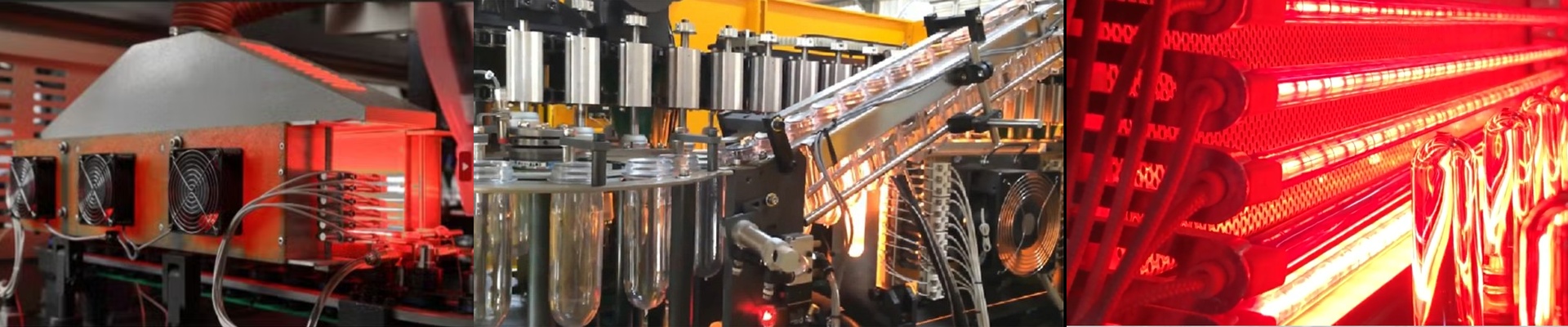

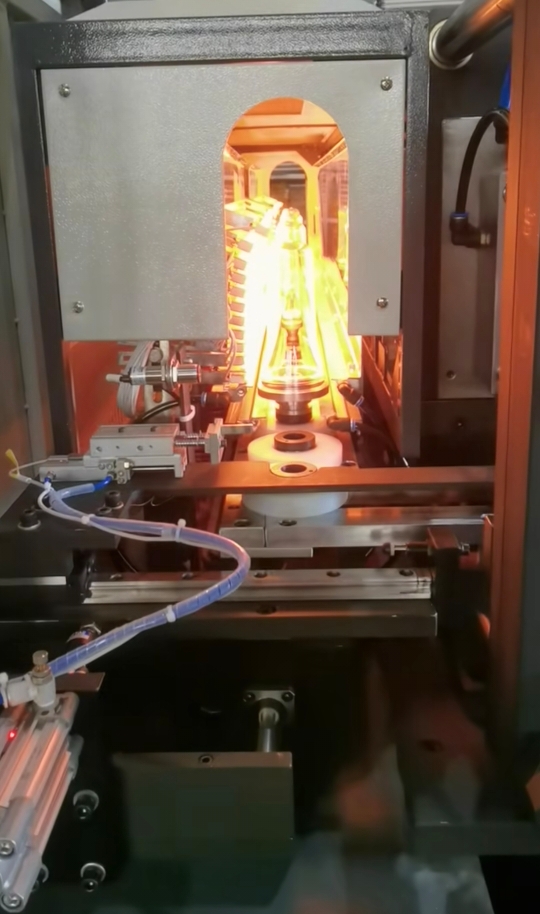
On the blow molding floor, PET heat-resistant preforms need tight thermal control. If the heating tunnel drifts even 5°C off setpoint, you’re dealing with stranded necks, blown sidewalls, or weak stretch. Downtime climbs while the scrap bin fills up. We built the PETC preform heater to drop in and replace OEM halogen/quartz emitters. It uses engineered infrared that matches the original machine geometry and power envelope. Here’s what matters in the specs: the PETC heater runs on 230V or 400V, with 1.5–3.0 kW per emitter, and it fits standard R7s sockets. You can spec short-wave quartz (tungsten filament, 0.78–1.2 µm) for fast response and high peak intensity. Or go medium-wave (carbon/alloy, 2–3 µm) for a broader, gentler profile. Either way, you get ±2°C stability at the preform neck and mid-body when setpoints are 120–160°C. Output is calibrated to 90–95% of rated power at 25°C ambient, and it drops only 3–4% after 5,000 hours. Why it works on real machines: the PETC is a 1:1 replacement on Sidel, Krones, SIPA, Husky, SACMI, and Nissei ASB blow molders. We match the watt density and beam pattern to the OEM reflector, so you don’t have to retune the whole heating tunnel. The payoff: cycle times stay in the 12–14 seconds per cavity, energy use drops 12–18% compared with halogen, and lamp changes come down by roughly 40%. Scrap from thermal non-uniformity is typically under 0.5%. A couple of shop-floor notes. Infrared heats line-of-sight, so keep preform spacing and rotation speed as specified—otherwise you’ll see banding. Before ordering, verify your machine’s voltage, connector type, and mounting dimensions. The retrofit itself is 2–4 hours, with a proper power disconnect and lockout. And if the reflectors are aging, you may need to re-plate or replace them to keep the original temperature profile.