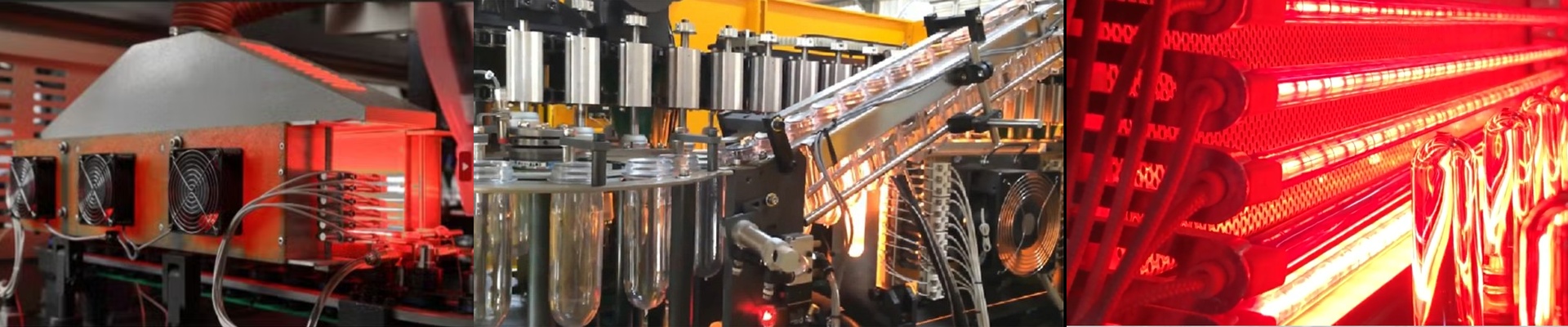

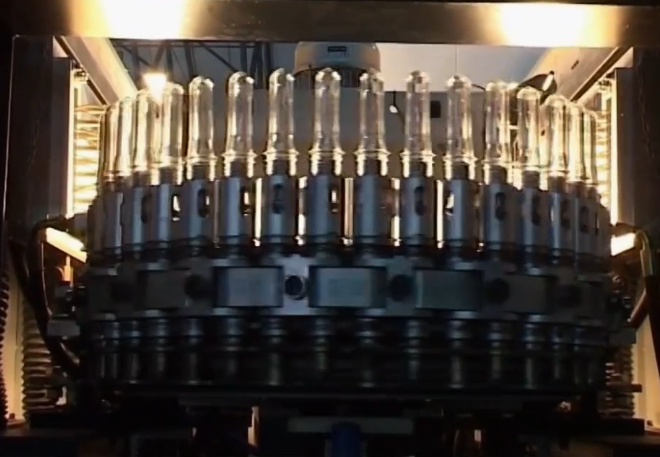
On a rotary blow molder, the heating tunnel is where the clock starts. If preforms undershoot or overshoot, the whole line pays for it—scrap, jams, and the line speed getting cut. We built our rotary heating units to hit the temperature curve the machine expects, cycle after cycle.
What matters, technically
We spec short-wave infrared quartz emitters tuned for fast, repeatable preform heating. Typical units run 1200–2400 W, 220–240 V, with tight tolerances on filament resistance and spectral output so the heating profile stays stable. The geometry is engineered to drop straight into standard rotary heating zones, with R7s (or equivalent) connectors and the right tube length and end-seal spacing to match the OEM mounting. We match emissivity and response time so the controller sees predictable behavior, and we size the power density to get you up to temperature fast without overshooting the setpoint.
Why it holds up in the real world
Rotary stretch blow molding demands consistent preform heating across multiple stations. Our heaters restore the designed thermal balance in Sidel, Krones, SIPA, Husky, SACMI, and Nissei ASB rotary blow molders, so you can keep wall thickness, clarity, and bottle weight consistent—even at full line speed. You’ll see faster recovery after startup, fewer temperature-related rejects, and output that stays stable when ambient conditions drift. Energy use drops because the emitters deliver heat on demand and cool quickly, avoiding idle losses.
The details that bite you if you ignore them
Installation is straightforward, but the details matter. Match voltage and polarity, verify reflector alignment, and confirm the thermocouple type and positioning so the control loop is reading the right signal. These emitters don’t forgive contamination—handle with clean gloves and keep the quartz free of oils and dust. Run at the rated voltage and you get life; push beyond it and you shorten it. If the machine has aging reflectors or cracked end seals, replace those first. Heater performance depends on the whole heating tunnel, not just the lamp.