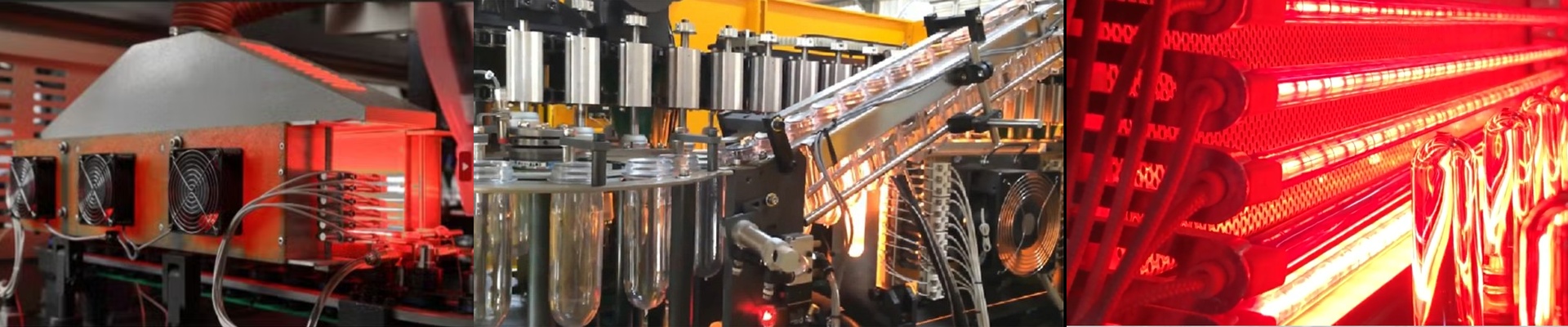
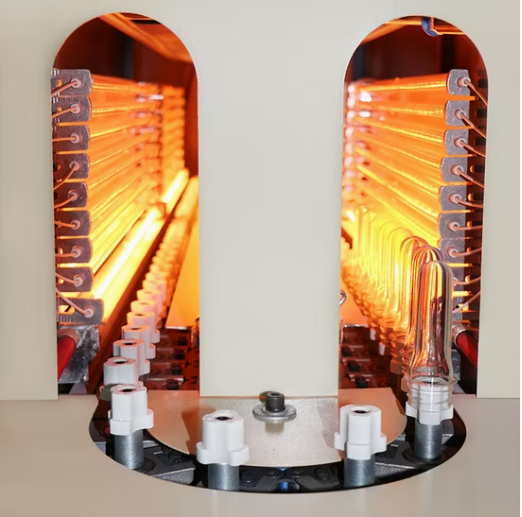
On the blow molding floor, uneven preform heating isn’t just a line-speed killer. It shows up as PET bottles with thin shoulders, stress cracks, and weight that drifts all over the place. When the heating tunnel can’t hold setpoint, you spend your shift chasing scrap and rework. We designed our clear quartz heating lamps to fix that—tuned for the thermal behavior of PET and the timing of stretch blow molding.
What matters, technically
These lamps use short-wave infrared to deliver fast, directional heat that penetrates the preform wall quickly and predictably. The quartz tube comes up to temperature fast, so the heating tunnel stays stable even when you change speeds. You can spec the emitter to match your blow molder: standard R7s connectors, 240V or 380V, and lengths that fit the common heating zones. We shape the spectral output to heat PET efficiently, so more of the energy goes into the preform instead of warming up the surroundings.
Why this works in stretch blow molding
Timing is everything in stretch blow molding. Fast, repeatable heating shortens cycle time and gives you more consistent biaxial stretching—so you get better bottle strength and less material give. Because the lamp hits temperature quickly, you get tighter temperature uniformity across the heating tunnel. Hot spots and weak zones drop off. The result: fewer rejects, less downtime for tweaks, and energy use that stays closer to the planned profile.
What you need to know up front
Installation is straightforward on most blow molding machines, but confirm the mounting bracket, reflector geometry, and zone wiring before you start. These lamps run hot. Proper clearance and airflow around the heating tunnel aren’t optional. For the longest life and stable output, keep the lamp clean and aligned, and match it to your blow molder’s control strategy. If you’re running very high line speeds, confirm the lamp power density against your specific preform wall thickness and cycle profile.